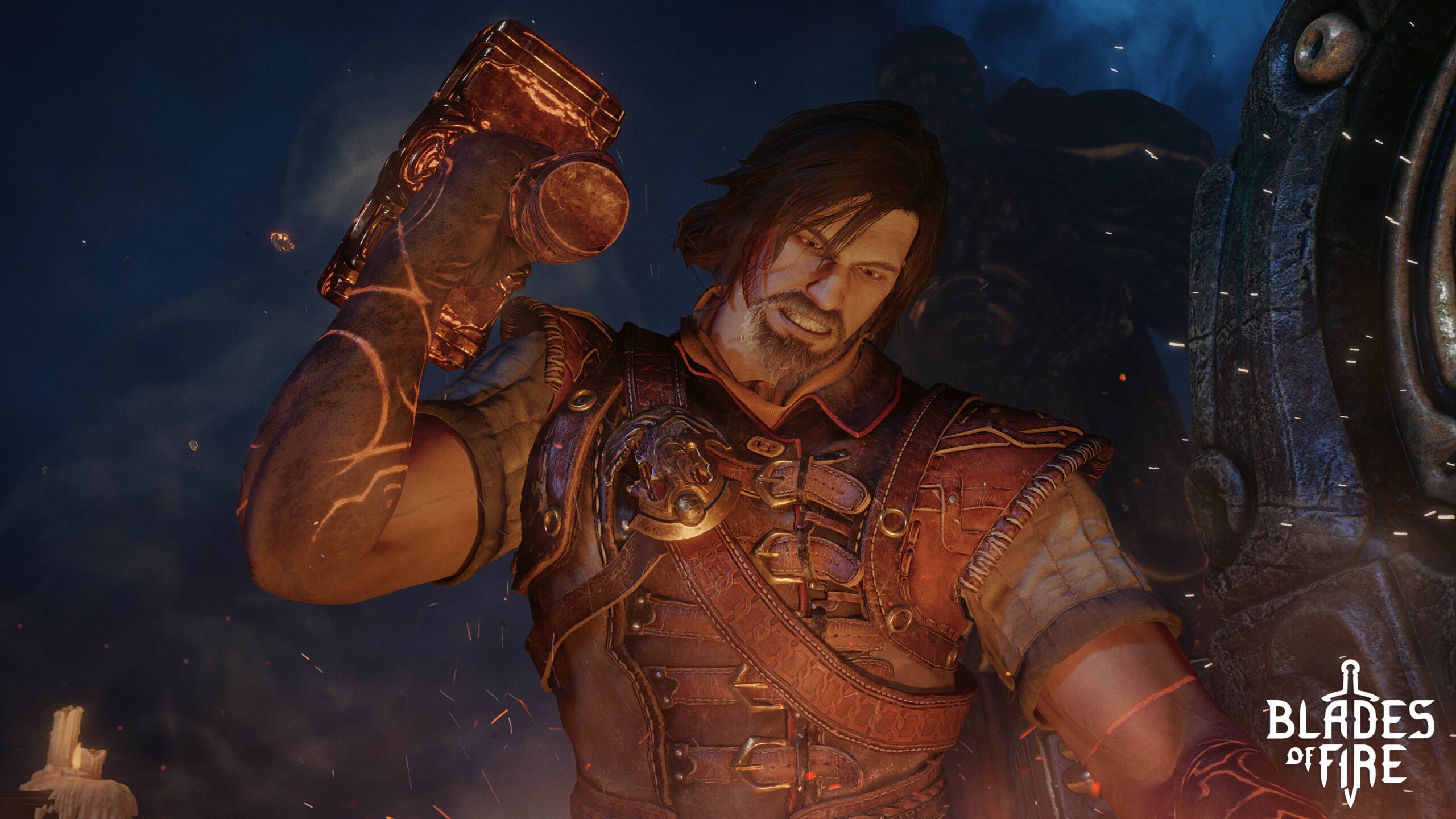
After delivering a number of successful titles since its founding in 2002—including the rebooted Castlevania: Lords of Shadow series and Nintendo’s Metroid Dread, which won Best Action Game at The Game Awards 2021—Madrid-based Spanish developer MercurySteam is back with a brand-new game: Blades of Fire. We spent dozens of hours playing through the main content and several side missions, and now we’re ready to present our full review of Blades of Fire. Let’s get straight to it!
Story
As always, we start our Blades of Fire review with the story. Long ago, the world was ruled by a race of giants known as the Forgers. These beings were not only physically powerful but also held deep knowledge of a mystical force called “Steel,” a form of technology that allowed them to forge weapons and reshape the world. Thanks to this power, the world experienced an age of prosperity. But as with all things, it eventually came to an end. After a devastating war and the collapse of their civilization, the Forgers decided to pass the secret of Steel on to humankind. With it, humans rose to become the world’s new rulers.
Unfortunately, peace didn’t last. Centuries later, a princess named Neria was transformed into an evil queen after a mysterious incident. Using powerful magical abilities, she cast a spell that turned steel into stone. Only her monstrous army could still wield the legendary metal, turning humanity’s greatest weapon against them. It’s your job to stop this threat.
The game opens quickly and enigmatically. You take on the role of Aran de Lira, who early in the game meets a scholarly young man named Adso de Zilk following a tragic event. Adso becomes your companion on a mission to infiltrate the royal palace and kill the queen, ridding the world of her dark reign. This mission is especially difficult for Aran, who was once close to the queen before her rise to power, as his father was once the royal guard captain.
The story spans about 40 hours—or over 60 hours if you aim to complete most of the game’s main and side content. Along the way, you’ll face obstacles ranging from puzzles to enemy mobs and powerful bosses, all standing between you and your goal.
Truthfully, the story isn’t one of the game’s strongest elements. It’s not terrible, but it lacks a strong plot, emotional twists, or real depth in its characters. The narrative feels more like a backdrop than a central focus. That said, the game does maintain an air of mystery, with secrets gradually revealed the deeper you go, giving you reason to keep playing.
Game World
The game features a semi-open world split into multiple regions. You can either fight or explore to collect crafting resources, solve puzzles with Adso’s help, or open treasure chests.
The world design is dark and medieval, drawing inspiration from Viking-era themes and titles like God of War. You’ll explore forests, swamps, snowy terrains, villages with Norse architecture, and imposing castles.
Enemy types vary by region. Villages and castles contain the queen’s soldiers, while forests are crawling with zombie-like creatures. This variety makes each area feel fresh and strategically distinct.
Gameplay

At first glance, Blades of Fire might seem like a typical third-person action-RPG. But once you step into its world, you’ll realize it offers something different. While the combat appears relatively simple, the game stands apart from conventional action-RPGs. Yes, it uses the familiar over-the-shoulder camera, but the focus here is not on character progression—it’s entirely on weapon crafting, upgrading, and customization.
Soulslike and Roguelike Inspirations
The game borrows many mechanics from Souls and Roguelike titles, including Dark Souls (FromSoftware) and Returnal (Housemarque). Gameplay is split into three main pillars: combat, blacksmithing (weapon crafting), and exploration, including puzzle-solving elements.
Combat
Set in a world reminiscent of medieval times, combat is based on melee weapons such as swords, spears, and hammers. This is where Blades of Fire shines. The combat is tactical, requiring you to observe enemy movements and time your attacks. For example, using Square and Circle (on PS5) allows you to strike from the left or right, while Triangle and X target the enemy’s head or torso. Every move matters—mistakes aren’t as punishing as in Souls games, but they do have consequences.
There are three difficulty modes: Easy, Normal, and Hard. The game includes a stamina bar (like Souls games) that drains as you attack or dodge. But here, stamina is recovered by entering a defensive stance (L2), not by consuming an item. When you die, you lose your weapon at the spot of death and return to the last checkpoint—a forge table where you can repair, recycle, or rest. Resting restores your health but also respawns all enemies except bosses.
Weapons Are the Core of the Experience

Unlike most RPGs where character development comes first, Blades of Fire flips the formula. There’s no skill tree or stat building for your hero. Everything centers on weapon creation and mastery.
The game features a separate dimension with a full workshop where you handcraft weapons. There are 7 weapon types and up to 30 blueprints for each type. Blueprints are unlocked by killing a certain number of enemy types (e.g., 60 of one type), a mechanic that can feel grindy and artificially extends the game length.
Crafting itself is impressively deep. You choose the weapon type, design, materials (which affect weight and durability), length (affecting range), and head shape (slashing, piercing, or blunt). You even name your weapons.
Then comes the forging minigame: a complex rhythm-like challenge where you control the strength, angle, and length of each hammer strike to match a guide curve. The better your precision, the more stars the weapon earns, which determines how often it can be repaired. A quick-craft option exists for players who prefer to skip the depth.
While weapon forging is fascinating, the lack of proper tutorials makes it confusing in the early hours. This can be frustrating, and the system would benefit from clearer guidance in future updates.
Combat Customization
Once you forge your weapon, you return to the main world to face 50 different enemy types. Each enemy responds differently to the three weapon damage types: slashing (edge), piercing (point), and blunt (impact).
Weapons wear down over time, losing effectiveness with each strike. You’ll need to manage weapon health carefully, saving your strongest weapons for boss fights and using sharpening tools to maintain them. Once durability is too low, weapons must be repaired or recycled.
In all, Blades of Fire offers deep tactical gameplay with standout features in its blacksmithing system. However, it suffers from repetitive bosses and grind-heavy mechanics like blueprint unlocking.
Graphics and Sound
If you’ve seen previews or played the demo, you might think Blades of Fire looks outdated. But it was never meant to be a AAA title with a massive budget. Its visuals are a deliberate artistic choice that suits the game’s mood, reminiscent of the Xbox 360 era.
Sound design is also solid: from the metallic clangs in the forge to sword clashes and slicing enemy flesh, the audio fits the world well. The soundtrack complements the setting but shouldn’t be expected to match blockbuster titles.
Final Verdict
Blades of Fire feels like a missed opportunity from MercurySteam. It introduces unique ideas with a deep tactical combat system and an exceptionally crafted blacksmithing feature. However, its weak story, repetitive content, and lack of character depth hold it back from greatness. That said, it’s still worth trying—especially for fans of Soulslike experiences.
Don’t forget to check out: