Since its initial reveal, Crimson Desert has felt like an ambitious project slowly unveiling its true scale. At one point, some players even questioned whether it would end up as another overpromised disaster like The Day Before, or simply a concept pitched to attract funding rather than a real product. However, as launch approached and more gameplay was showcased, it became clear that this was a genuinely ambitious title aiming to shift expectations within the industry — and to firmly establish Korean developer Pearl Abyss as a major force.
After spending more than 200 hours with the game, here is our full Crimson Desert review — and the answer to the most important question: Is it actually fun, and is it worth your time?
Story Overview (Spoiler-Free)
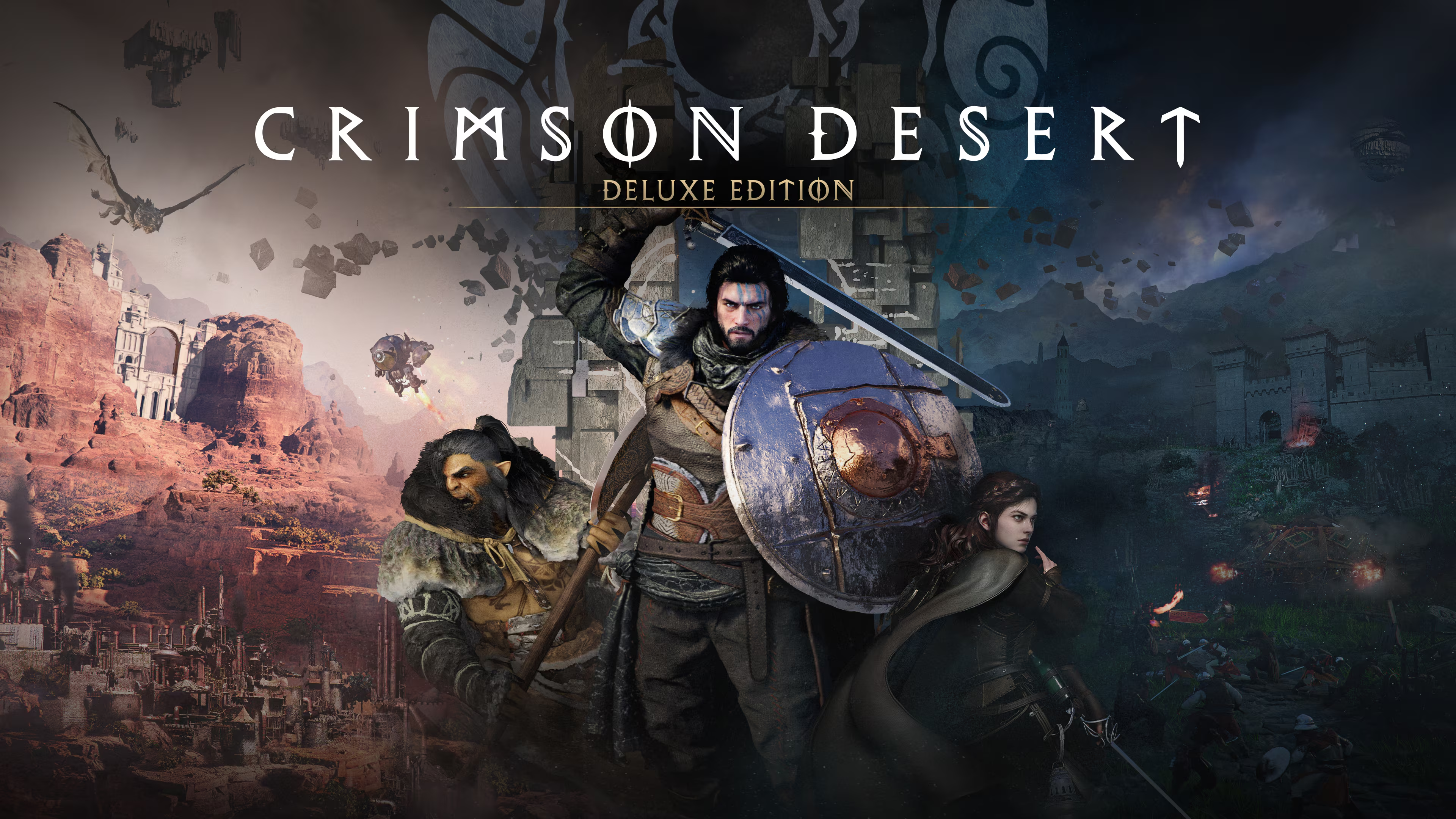
The story follows Kliff and his faction, the Greymanes — a brotherhood-driven tribe whose origins remain largely mysterious. The game opens at the collapse of their stability, as a massive battle erupts between them and a rival group known as the Black Bears. The conflict ends in defeat for the Greymanes, scattering their members across the continent.
From there, Kliff embarks on a journey to reunite his fractured family across the war-torn continent of Pywel — a land marked by civil war, destruction in some regions, and prosperity in others. The game features five major regions. It begins in Hernand, which alone took me nearly 50 hours to explore without even completing all its content. The journey continues through Pailune, Demeniss, Delesyia, and finally the Crimson Desert itself, the region that gives the game its name.
The main story spans 12 chapters and takes roughly 80 hours if you focus solely on narrative progression. Realistically, however, that approach is nearly impossible. Boss encounters demand constant upgrades to your abilities and equipment, requiring heavy investment in side content.

The narrative introduces a wide cast of characters and political conflicts, sometimes to the point of confusion. Midway through, the story loses some of its emotional impact before regaining momentum in the final two chapters. Rumors suggest the script underwent multiple rewrites — potentially tied to the project’s shift from an MMO structure to a single-player experience — and that inconsistency is noticeable.
At its core, the story blends kingdom conflict themes reminiscent of The Witcher 2: Assassins of Kings and Assassin’s Creed Valhalla, combined with supernatural elements tied to Kliff’s magical abilities and the floating islands known as The Abyss. This mystical layer proves far more compelling than the human political drama.
Kliff himself lacks charisma. It appears the developers attempted to mirror Geralt’s stoic personality from The Witcher 3: Wild Hunt, but the result feels more emotionally muted than intentionally reserved. Supporting playable characters include Damiane, a swift and agile warrior, and Oongka, a powerful orc fighter. Oongka stands out both narratively and mechanically, particularly with his exclusive jetpack ability, and deserves further exploration in future expansions.
Overall, the story structure is ambitious but uneven. The foundation is strong enough to support a future franchise, yet execution varies in quality.
Gameplay: An Ambitious Fusion That Mostly Works

Before playing, my biggest concern was the game’s attempt to include “everything” — borrowing systems from multiple genres. Surprisingly, this fusion largely succeeds. Crimson Desert delivers one of the most mechanically dense open-world experiences in recent memory.
You can easily spend 500 hours engaging in varied activities: hunting, gathering, crafting, upgrading gear, horse racing, wrestling, card games, environmental puzzles, and more. These activities represent only a fraction of the available systems — and they meaningfully feed into progression.
The game is built around layered systems. Core systems include traversal, combat, crafting, and upgrading. Secondary systems range from camp management and banking to crime systems, faction relationships, artifact collection, cooking, and deep exploration mechanics.
Exploration is the strongest aspect of the game. Discovering new traversal tools or unexpected items — such as rideable creatures, explosive arrows, or unique equipment — significantly alters your playstyle. Few games deliver this level of discovery-driven progression, perhaps only comparable to certain Zelda entries.

Combat begins with sword-and-shield gameplay but expands into dual-wielding, two-handed swords, blunt weapons, bows, stamina management, Spirit abilities, horseback combat, gliding mechanics, and even wrestling-style grapples like the RKO. The flexibility in combat customization is impressive.
However, boss design is inconsistent. Major story bosses are cinematic and thrilling, while many mini-boss encounters suffer from difficulty spikes and repetitive design — particularly human bosses, who share similar builds and magical ranged abilities.
Quest design is more conventional. Many missions revolve around gathering items, reading documents, and culminating in a boss fight. Compared to the quest richness of The Witcher 3: Wild Hunt, Crimson Desert feels mechanically broader but narratively thinner in mission structure.
Puzzles, on the other hand, are excellent. Some require genuine out-of-the-box thinking and may leave players stuck for extended periods — a refreshing design choice in an era of overly guided experiences.
Resource Management and Systems Depth

Inventory management plays a critical role. Your storage begins limited but expands through upgrades and side requests. Resource gathering fuels cooking, weapon crafting, camp expansion, and auxiliary systems like banking and faction missions.
Boss encounters often require careful preparation through consumables and buffs. While the difficulty does not match Souls titles, certain encounters feel artificially challenging due to design imbalance rather than mechanical mastery.
Graphics and Technical Performance

Crimson Desert runs on the in-house BlackSpace Engine developed by Pearl Abyss. Technically, it is one of the most impressive engines currently in use. On PlayStation 5 performance mode, the game maintains over 60 FPS for the majority of playtime, with occasional drops during large-scale battles.
The draw distance is exceptional, environmental diversity is striking, and visual density rarely compromises performance. On high-end PC or PlayStation 5 Pro, the game feels definitively next-generation.
Audio performance is strong overall. Voice acting is solid, though Kliff and Damiane suffer from the script’s uneven direction. The soundtrack is fitting and diverse, though not particularly iconic.
Facial animations remain a weak point, resembling older large-scale RPGs rather than cutting-edge character modeling.
Crimson Desert Review Final Verdict

My journey with Crimson Desert moved from curiosity and skepticism to genuine satisfaction. After 200 hours, I can confidently say it succeeds in its primary goal: delivering a deeply engaging and mechanically rich open-world experience.
It may not tell the tightest cinematic story, but it excels in exploration, systems depth, and player freedom. Crimson Desert stands as one of the most ambitious and rewarding open-world action titles of this generation.
Don’t forget to check:
Crimson Desert Review
My journey with Crimson Desert moved from curiosity and skepticism to genuine satisfaction. After 200 hours, I can confidently say it succeeds in its primary goal: delivering a deeply engaging and mechanically rich open-world experience. It may not tell the tightest cinematic story, but it excels in exploration, systems depth, and player freedom. Crimson Desert stands as one of the most ambitious and rewarding open-world action titles of this generation
8.5
Pros
- Exceptional open-world exploration
- Deep and varied gameplay systems
- Highly customizable combat
- Strong technical performance and visuals
- Challenging, intelligent puzzles
- Meaningful progression systems
Cons
- Weak protagonist charisma
- Repetitive and uneven boss design
- Inconsistent story pacing
- Underutilized NPC interaction system
- Stiff facial animations
- No Arabic language support
