When Cronos: The New Dawn was first announced, I thought it might simply be a “clone” borrowing heavily from Dead Space, one of the most iconic sci-fi horror action games ever made. But after playing it, I realized the similarities are only surface-level, as we’ll discover in our Cronos: The New Dawn review.
At its core, Cronos is a new and much-needed experience for the horror genre. And with Bloober Team releasing both Cronos and the Silent Hill 2 Remake in the same year, it’s fair to say we’re living through a renaissance for horror gaming. Here’s our Cronos: The New Dawn review and why it’s one of the most important releases of 2025.
Story – Mystery from Start to Finish

The story of Cronos is drenched in mystery, reminding me more of Alan Wake than of Dead Space or Silent Hill 2. Unlike those games, where the narrative becomes clear by the ending, Cronos deliberately raises more questions, hinting at sequels or expansions.
The plot revolves around The Travellers, time explorers working for a future organization called The Collective, which sends them back to the 1980s to extract “Essence” from key figures. This mission follows a cataclysmic event known as The Change, which reshaped the world and gave rise to The Collective’s shadowy influence.
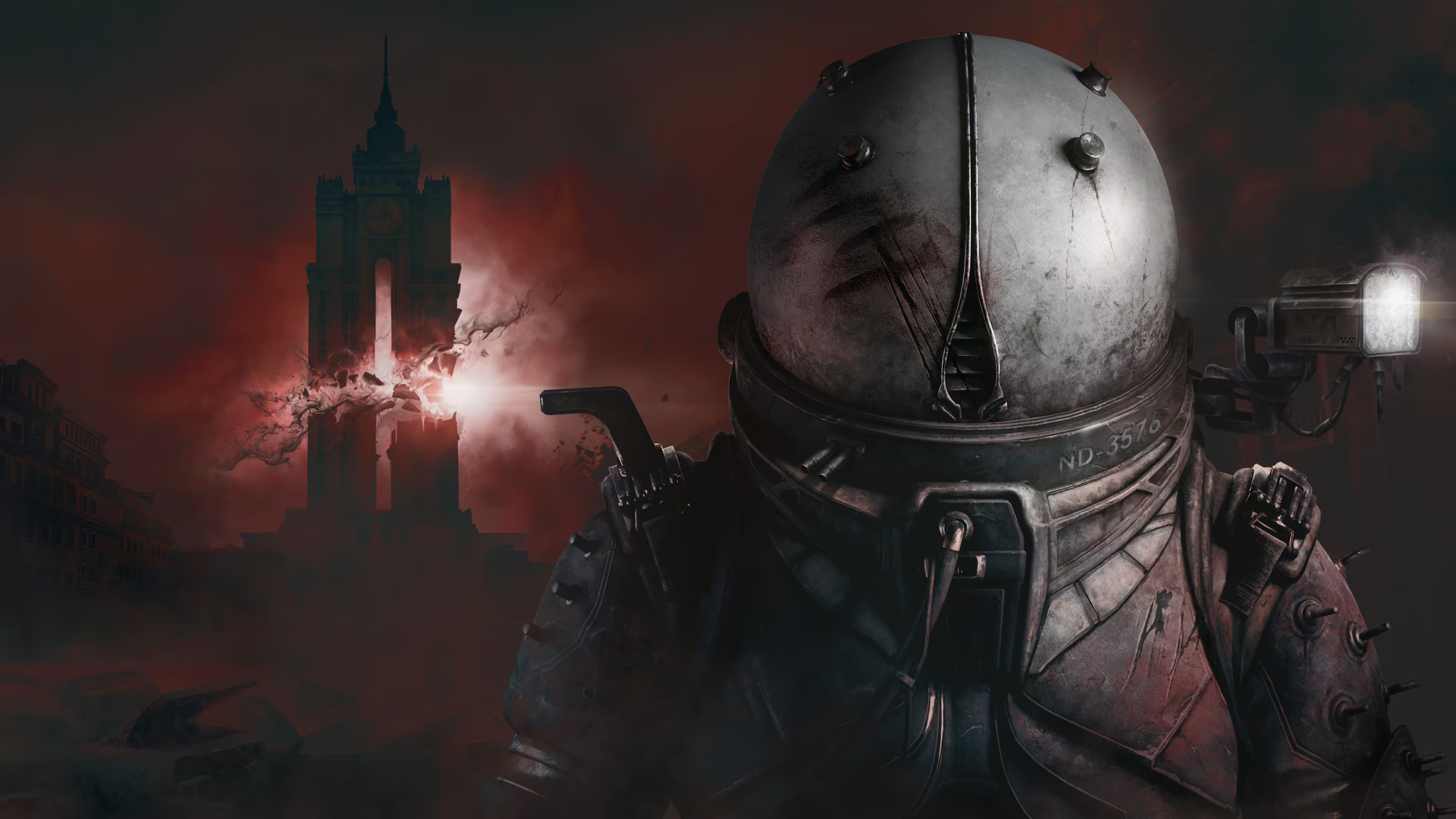
Travellers operate alone, each replacing the previous one upon death. They’re equipped with heavy armored suits, and weapons capable of shifting forms—like a shotgun mode, a chargeable pistol, or an assault rifle. These tools are used to combat The Orphans, mutated humans trapped by The Change.
The game’s lore is deep, spanning centuries past and future, with layers of secrets that may never fully be revealed. Storytelling leans heavily on environmental cues and scripted events, supplemented by occasional narration and cinematic cutscenes. Still, the focus is on the world and its mysteries, rather than fully fleshed-out characters, setting it apart from something like Silent Hill 2.
Gameplay – Survival Meets Strategy

Cronos: The New Dawn is a linear narrative-driven game with interconnected environments. Some areas are large and Metroidvania-like, while others are tight and linear. Combat is frequent and brutal, leaning more toward action than many horror games where fighting is secondary. Still, there’s a fine balance between horror and action that keeps both elements strong.
The standout mechanic is the shapeshifting weapon, which can adapt to different styles of combat. Encounters feel strategic thanks to an innovative feature: enemy fusion. If you don’t burn enemy corpses after killing them, living enemies can fuse with the dead ones, creating stronger monsters. Fire is scarce and crafted at Safe Rooms using resources that might otherwise go toward healing or ammo. Every choice carries consequences, adding tension and depth.
Resource management is a constant source of suspense. You’ll make frequent runs back to Safe Rooms to craft supplies, often interrupted by dangerous ambushes. Unlike The Callisto Protocol or Silent Hill 2, there’s no block or dodge system—forcing you to rely on awareness, strategy, and resource use.
Enemy variety is strong, each with distinct movement patterns and attack styles. The combat is built around constant movement, separating it from Dead Space or Alan Wake 2. Still, narrow environments sometimes restrict mobility, leading to frustrating encounters—like being cornered by eight enemies in a small space. It’s punishing, but eventually rewarding once you adapt.
The game doesn’t rely much on puzzles, though there are environmental challenges that force you to backtrack with new tools to unlock paths. This Metroidvania-style design works well, though not as polished as Bloober’s work on Silent Hill 2 Remake.
Music and Visuals

The music is tense and emotional, perfectly complementing the sci-fi-meets-horror atmosphere. It conveys loneliness, strangeness, and timelessness, immersing you deeply in the setting.
Visually, Cronos is Bloober Team’s most polished work yet. Unlike the uneven quality of Silent Hill 2 Remake, the environments here are consistently detailed and atmospheric. From an industrial station filled with layered details to a hauntingly designed hospital stage—arguably one of the best horror levels ever created—the game nails its world-building.
For the first time, Bloober delivers visuals that feel truly AAA, marking a major step forward for the studio.
Technical Performance

The game offers both Performance Mode (prioritizing framerate) and Quality Mode (prioritizing visuals). I played on Performance Mode and still encountered occasional frame drops, which was disappointing but understandable for a project of this scale.
Ideally, a smoother launch would have given everyone the best experience from day one.
Cronos: The New Dawn Review Final Verdict
Cronos: The New Dawn is easily one of the best new horror IPs in years. With an enthralling sci-fi world, deep lore, and unique gameplay mechanics, it stands alongside the genre’s biggest names. While it lacks complex puzzles, the overall atmosphere, combat design, and storytelling more than make up for it.
Bloober Team has officially graduated from being a “small indie horror developer” into competing with the big studios. After the disappointment of The Medium, they’ve proven themselves with Silent Hill 2 Remake and now Cronos, solidifying their reputation as a serious force in horror gaming.
Don’t forget to check:

Adorei conhecer seu blog, tem muito artigos bem interessantes.