Five years after delivering one of the strongest PlayStation 5 exclusives of the generation with Returnal, Housemarque returns with Saros — a spiritual evolution that refines many of Returnal’s core ideas. The new title builds on the same foundations but introduces notable gameplay improvements.
Unfortunately, in attempting to make the experience more accessible, the studio falls into a major trap: smoothing out the difficulty to the point where part of what made Returnal special is lost.
Here is our full Saros review.
Story: Mysterious and Symbolic

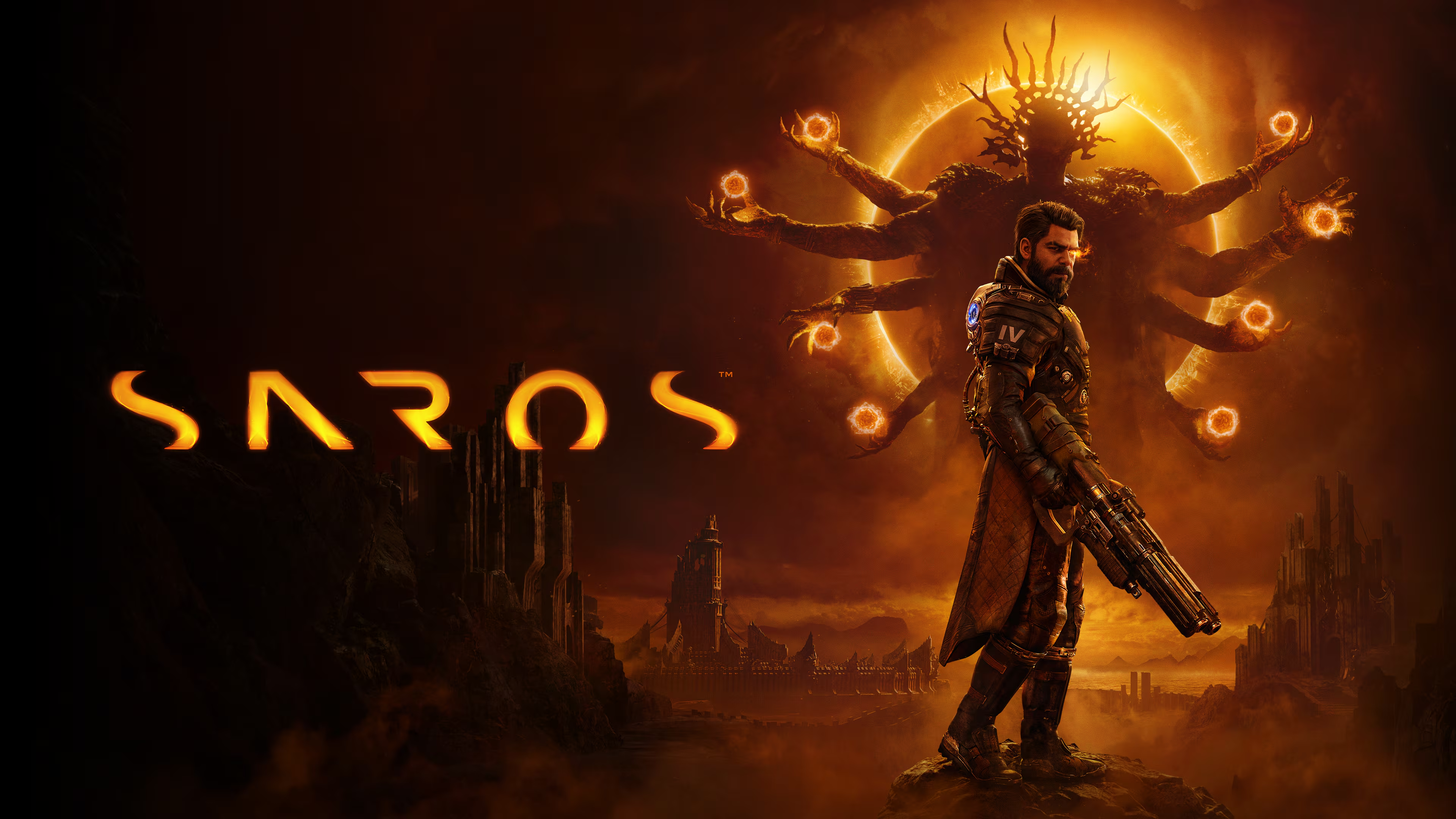
Saros takes us to the planet Carcosa, where we play as Arjun, a member of the Echelon 4 expedition. He is sent to investigate after three previous teams mysteriously vanished. The mission is to uncover what happened and report back to Earth about Carcosa’s potential, as the planet is believed to contain advanced technology and valuable resources that could benefit humanity.
What gives the story emotional weight is its personal dimension. Arjun’s wife was part of the first expedition, Echelon 1. His mission is not purely professional — it is deeply personal. He seeks answers about her fate, and as the narrative unfolds, we uncover layers of their complicated relationship along with the planet’s secrets.
The storytelling approach mirrors Returnal’s style: fragmented, interpretive, and symbol-heavy. It may not appeal to everyone, but it fits the game’s focus on atmosphere and gameplay rather than cinematic exposition.
Gameplay Is the True Star of Saros

Like Returnal, Saros is built around a roguelike structure and bullet-hell combat design. However, Saros is noticeably more forgiving.
In Returnal, death meant restarting from the very beginning. In Saros, you simply replay the stage where you fell. This alone dramatically lowers the difficulty curve and makes the experience far more accessible.
Combat remains fast and demanding. You face waves of enemies unleashing relentless projectile patterns. Movement, positioning, and reaction speed remain essential. However, Saros introduces more enemy variety and new mechanics — most notably a shield system.
Enemy projectiles now come in three types:
Blue projectiles can be absorbed using your shield, filling a special energy meter that powers devastating counterattacks.
Red projectiles cannot be blocked and must be dodged entirely.
Yellow projectiles can be collected, but doing so increases corruption, which reduces health while simultaneously empowering certain weapons.
This dynamic system adds depth and encourages risk-versus-reward decision-making.
However, the biggest change comes in progression design. Saros introduces a permanent skill tree. Even if you die repeatedly, your character becomes stronger over time. Eventually, you can overcome challenges simply through upgrades.
This design makes the game more approachable — but it removes the raw, run-based mastery that defined Returnal’s identity.
Boss Design and Difficulty
One of the most disappointing aspects is boss encounters. Compared to Returnal, boss fights in Saros are significantly easier and lack variety. Some regular encounters during stages feel more threatening than the actual bosses.
While this makes the game accessible to a broader audience, it reduces the sense of accomplishment that made Returnal so memorable.
Overall, Saros is not boring — far from it. But it is undeniably simpler and less punishing. For players who thrived on Returnal’s intensity, this shift may feel like a step backward.
Visuals and Technical Performance

On a technical level, Saros is stunning.
Built using Unreal Engine 5, the game features eight visually distinct environments. Every location feels handcrafted, filled with detailed enemy and boss designs. Many scenes could easily pass as high-quality wallpapers.
Performance on PlayStation 5 is excellent. The game runs at a stable 60 frames per second with no noticeable drops. In a bullet-hell experience where responsiveness is critical, this level of technical stability is essential — and Housemarque delivers.
Saros Review Final Verdict

Saros offers an enjoyable and visually impressive experience. It refines Returnal’s core systems, introduces meaningful combat additions, and broadens accessibility.
However, in smoothing out the difficulty and implementing a permanent skill tree, it sacrifices part of the identity that made Returnal stand out. Saros is not a weaker game — it is simply aimed at a wider audience.
If you are looking for a visually spectacular, fast-paced roguelike shooter with manageable difficulty, Saros is an excellent choice. But if you crave punishing challenge and tightly designed boss encounters, Returnal may remain the stronger experience.
Don’t forget to check:
Saros Review
Saros offers an enjoyable and visually impressive experience. It refines Returnal’s core systems, introduces meaningful combat additions, and broadens accessibility. However, in smoothing out the difficulty and implementing a permanent skill tree, it sacrifices part of the identity that made Returnal stand out. Saros is not a weaker game — it is simply aimed at a wider audience. If you are looking for a visually spectacular, fast-paced roguelike shooter with manageable difficulty, Saros is an excellent choice. But if you crave punishing challenge and tightly designed boss encounters, Returnal may remain the stronger experience.
8.5
Pros
- Fast and satisfying gameplay
- Meaningful refinements over Returnal
- Strong enemy and mechanic variety
- Stunning visuals and stable performance
- Excellent Arabic support with full voice dubbing
Cons
- Significantly easier than Returnal
- Underwhelming boss encounters
- Skill tree reduces overall challenge
