
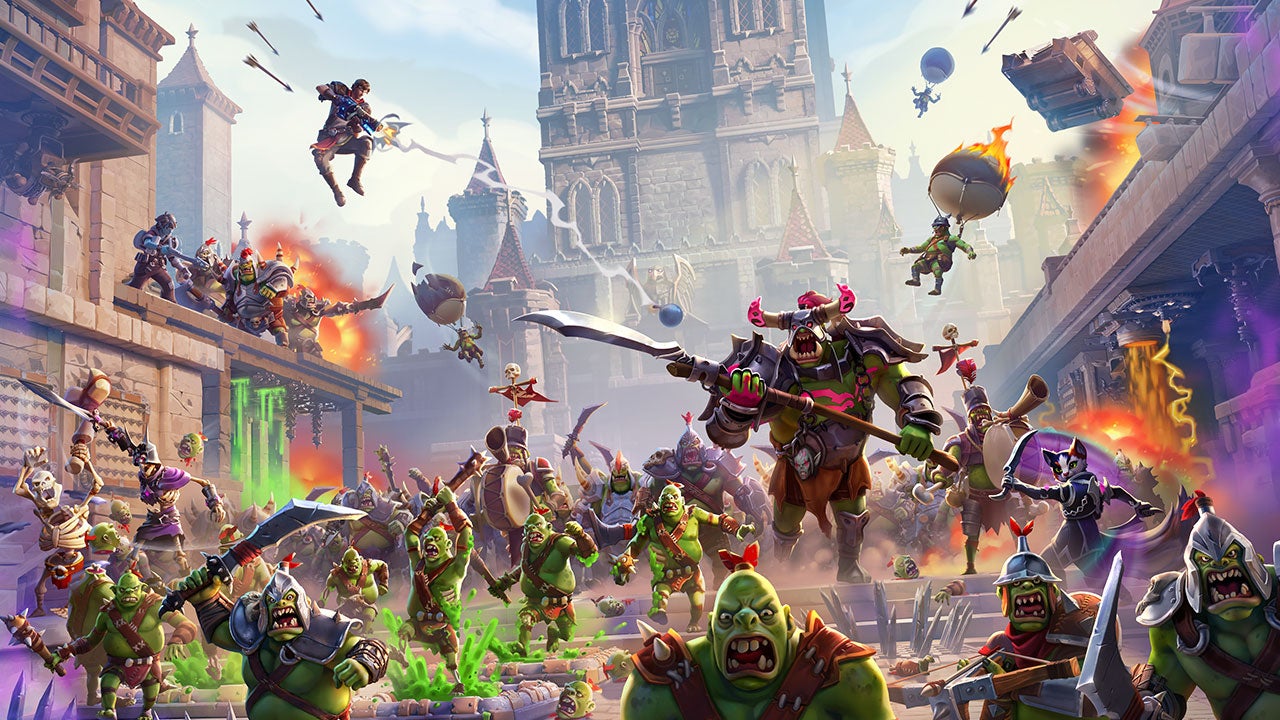
For over a decade, the Orcs Must Die! series has blended frenetic third-person combat with smart tower-defense strategy. From its 2011 debut to today, the franchise has been synonymous with co-op fun, clever traps, and gloriously chaotic encounters. With the new entry, the studio takes a risk—steering the series toward a roguelite-inspired direction. In this Orcs Must Die! Deathtrap review, we look at where it preserves the series identity, what it improves, and where it stumbles.
Story and Lore (No Spoilers)

Following the events of Orcs Must Die! 3 and the fall of Rift Lord Vorwic, the orcs don’t disappear—instead they splinter into four rival factions, each led by a powerful general with unique tactics and motives.
There’s no traditional campaign mode here; the story isn’t presented in-game and is instead summarized on the official website. In short: the orc army fractures, the realm descends into chaos, and you—the War Mage—must defend the world’s magical rifts as the four factions assault you with different styles and escalating threats.
Each faction attacks in distinct ways. Some favor brute force, others rely on trickery, and flying enemies can heal their allies to make encounters tougher. With every wave, the pressure rises, forcing you to think carefully about trap placement and hero selection.
Gameplay

Balancing difficulty for solo and co-op was one of the biggest hopes for Deathtrap—and much of the fun lies in meeting that challenge head-on. Co-op does add a big dose of laughter and planning, but solo play remains tense and rewarding in its own right.
From the first run, the loop is immediately engaging. As a roguelite, the game pits you against relentless waves pushing toward the rift you must protect. Let too many through and the run ends, sending you back to your stronghold to rethink your build.
You start each mission with a budget to deploy traps: ceiling lasers, flame pits, flying saws, auto-ballistae, launch pads, and more. When the wave begins, you watch your plan erupt into chaos as orcs are shredded, launched, or incinerated—equal parts gory and comedic. After each wave, you pick a “Thread” to add a new modifier or perk, pushing your build in a specific direction.
Threads function like cards with simple but useful effects—boosting a hero ability, adding health, or amplifying damage for specific trap types. Maps also force you to adapt: castles have low ceilings and plenty of walls for lasers; open courtyards restrict those options and demand different trap layouts.
Difficulty scales steadily. Enemies grow bulkier, meaner, and more varied, with pesky fliers that heal their allies. While you can unlock and upgrade more traps between runs, the different War Mages also change how you play.
I gravitated toward Wren for her solid staff damage and ability to trigger nearby traps, but fell in love with Sophie, a cat who specializes in necromancy and minion play.

At the start of a mission you choose one of three maps, but the roguelite flavor runs deeper. After each wave, every player chooses from three Thread options that can affect traps, the hero, and more. Many are straightforward (e.g., +10% crit chance for ceiling traps), while others introduce risk-reward tradeoffs. Some picks dramatically change your build—like doubling barrier width so you can place twice as many.
As in other roguelites, you must decide when to stop advancing to preserve the skulls you’ve collected for permanent upgrades. Pushing on may yield bigger rewards—but failing the next stage means fewer resources overall.
Meta progression is traditional: unlock and upgrade traps, and spend points in each hero’s skill tree to boost starting stats. It’s serviceable, not revolutionary—mostly number increases that make the next run smoother. The roster starts with six heroes of varied melee/ranged playstyles, plus a secret seventh to unlock. In co-op, each player must pick a different hero, encouraging team compositions—though it can sting if someone grabs the one you’ve heavily upgraded.
Trap variety remains the star—wall, floor, and ceiling options are plentiful. Co-op limits the total traps you can place but often makes planning and coordination more enjoyable.
If you’ve played earlier Orcs Must Die! games and enjoy modern roguelites like Hades or Vampire Survivors, you’ll have a good idea of the cadence here. Be aware, though: maps are very large and variety tails off after a handful of runs. Some usability gaps—like missing minimap markers for dropped items—make it easy to overlook pickups, especially solo when you can’t safely abandon the rift.
A few design decisions will divide series veterans. Barrier usage is more restricted, enemy variety feels limited, and late-stage runs can stretch for a very long time—sometimes over two hours. Progress can only be saved between missions (not between waves), and that’s solo only; co-op has no save, and if the host disconnects, the run ends.
In short: if you already love Orcs Must Die! and have friends to play with, Deathtrap can deliver dozens of entertaining hours. Your mileage will depend on how you feel about the changes. The roguelite elements add spice but don’t fully justify dropping a campaign, and the biggest issue is limited variety compared to roguelites that radically remix every attempt.
Performance and Audio

On PS5, Deathtrap is largely stable, holding a high, steady frame rate even when screens are packed with enemies and trap effects. Minor hitches can occur during late-wave visual pileups but don’t meaningfully hurt the fun. Load times are fairly quick, and moving between maps is smooth.
Artistically, the series’ exaggerated cartoon style returns with darker touches to fit the roguelite tilt. Enemy designs range from basic orcs to nuisance fliers, with slapstick death animations that keep the tone light despite the carnage. Maps are thoughtfully built, with clear contrasts between confined castles and open arenas that force different strategies. Color palettes pop, and the worlds feel lively even when details are intentionally simple.
Audio delivers punchy feedback. The soundtrack ramps tension wave by wave, shifting up a gear as danger rises. Trap sounds are satisfyingly distinct—from the thunk of ballistae and the buzz of saws to the hiss of lasers—giving each tool an audible identity. Orc shrieks and reactions add comedic relief that keeps the chaos fun rather than stressful.
Orcs Must Die! Deathtrap Review Final Verdict
Orcs Must Die! has always been best with friends—third-person combat fused with tower-defense where you juggle waves while guarding one or more rifts. Across three main entries, the formula expanded with new traps, heroes, enemies, and maps while retaining its core. Deathtrap charts a different course: leveraging roguelite popularity by replacing a campaign with bite-sized missions and gradual progression.
On paper, the pitch is promising—carry forward the great core gameplay, then add roguelite randomness for fresh runs. In practice, the result is mixed: some will welcome the shake-up, while others will miss the traditional campaign, broader enemy ecology, and stronger variety. There’s plenty of fun here, especially in co-op, but the newcomers’ features don’t always add the depth you’d expect.
Don’t forget to check: